Is there a physicality of the daily communicative life of a person who lives between languages? Can a poem be a body?
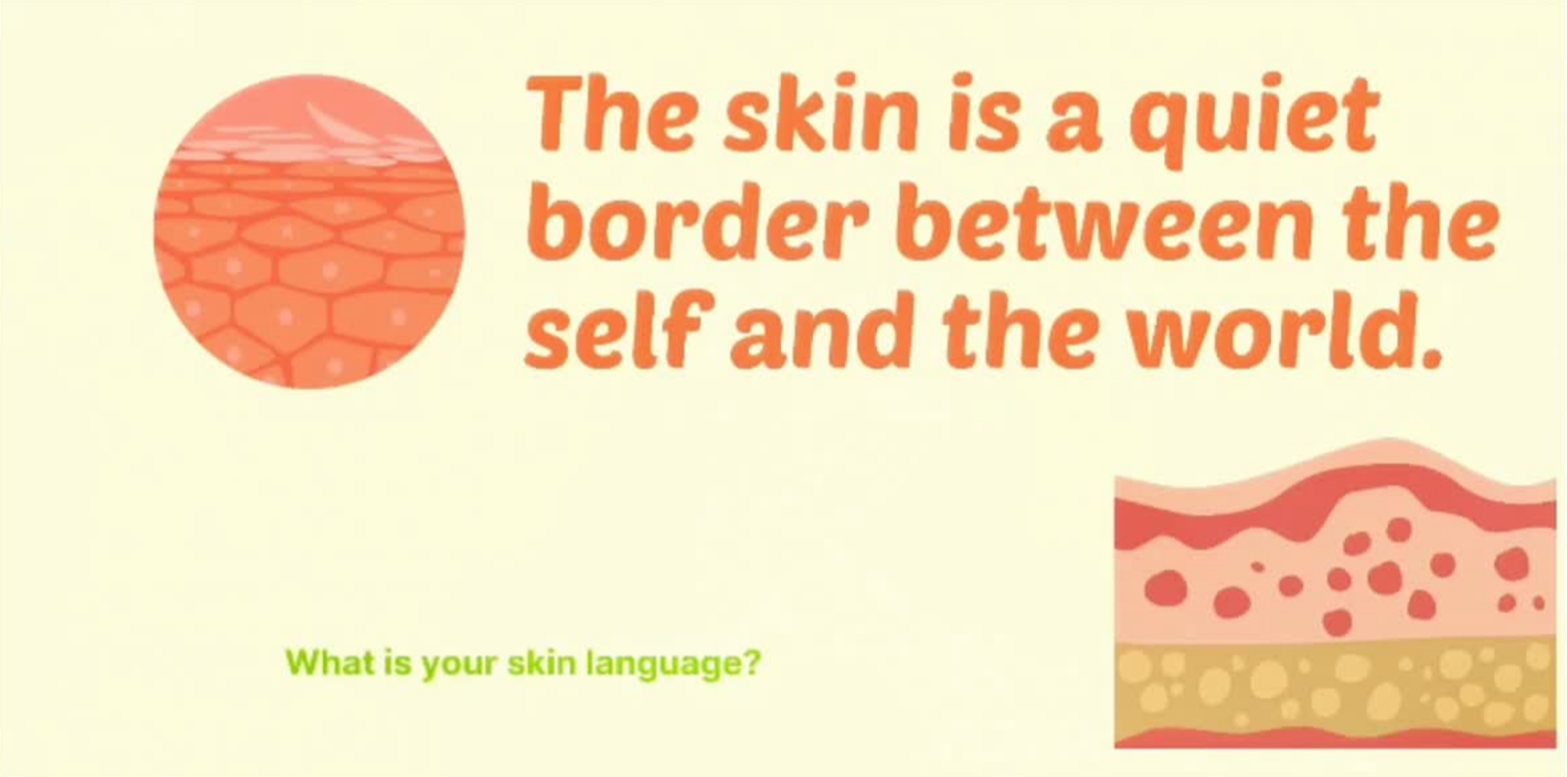
Human skin is a quiet border between the self and the world. It is the body’s first language, feeling light, cold, warmth, and touch before the mind names them. Soft yet resilient, it holds our warmth, remembers every scar and caress, and breathes with the subtle pulse of life beneath it. Through it we are both protected and revealed, a living surface where the invisible interior meets the open air.
Your Task (20 minutes)
In this exercise we will think of a poem, within the limits of our languages, as a body. Assuming that you speak two or more languages, I would like you to pick the most fragile of them. This language will become the skin. It could be the language you are learning, the language you struggle the most with, the language it tears the most easily, the language that, just like your skin, is the most exposed, the one that makes you feel naked. You will write a poem in that language. In my case, the skin language would be Icelandic.
- Take two minutes to face the nudity (3 minutes): You are about to reveal your skin, perhaps for the first time, to yourself. Seeing oneself naked in a mirror for the first time can be both a wonderful experience and a scary one. Close your eyes and take the next two minutes to meditate about what is about to happen. Writing in an imperfect language can be difficult, but this exercise is about creating the beautiful layers of a perfect body. I would encourage you to allow yourself to be imperfect, to embrace the level you have in the language you have chosen. It doesn’t matter if you have a high level, a medium level or a low level. This is your linguistic skin. See it, embrace it, love it.
- Start writing (15 minutes): Once you have seen your skin in the mirror, it is time to let it express itself in the paper. Try to think in the chosen language rather than translating in your head. Take one of your pieces of translucent paper and write a poem. Write what you can in the chosen language. Do not worry about the grammatically correctness of what you are writing, for this exercise we can be ourselves. If you meet a point in which you do not know a word or a sentence in the chosen language, leave a blank space. It is very important you do not fill in the space with any word in any language.
- Reflection (2 minutes): Look at the skin of your poem. Are there any blank spaces? If so, how do the blank spaces make you feel?