
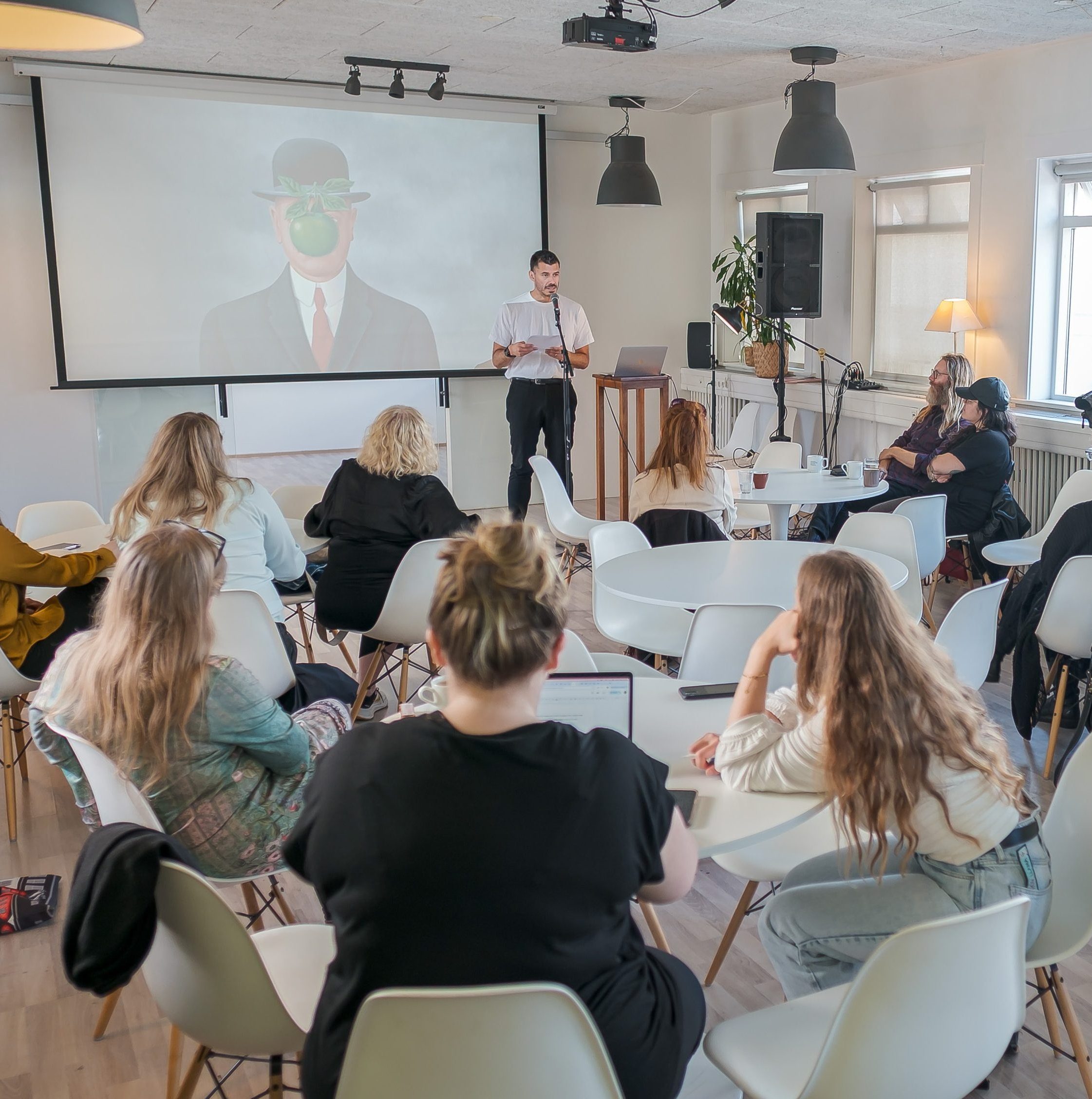
Theoretical Focus:
We turn to opsis—the spectacle—not as passive consumption but as a ritual act of ecological witnessing. Pierre Bourdieu’s notion of the pre-symbolic reminds us that before words or symbols intervene, the body apprehends the world through urgent, lived presence. Tom Bristow’s reflections on visual memory help us consider the Anthropocene as a theatre of both emergence and disappearance—where biodiversity, habitats, and cultural memory are simultaneously lost and reimagined. In this frame, image-making is neither neutral documentation nor aesthetic detachment. It becomes an embodied practice of testimony—an affective and political presence. We will work with Ana Mendieta’s earth-body works and Cecilia Vicuña’s visual poems, whose practices enact kinship, mourning, and re-emergence through ritualized seeing. Through their lens, we consider how the visual holds grief without immobilizing it, and how it can invite potential rather than closure. Donna Haraway’s provocation to “make kin” beyond genealogical lines pushes us to think of seeing as an act of relation-making, a means to compose care between kinds and assemblages. In this week’s work, vision is understood as interbeing: to look is also to touch, to acknowledge, and to enter into reciprocal presence.
Practices:
- Walk-and-draw exercises: observe and sketch species, detritus, or scars on the land
- Introduction to eco-visual artists: Cecilia Vicuña, Ana Mendieta, as well as several contemporary multimedia artists.
- Use of found natural materials in poetic illustration or collage
Exercise:
Design a visual poem or image-collage using bioregional materials that reflect intersections of ecological grief and family memory. Consider the role of shame in visibility, as explored in Probyn’s Shame in the Habitus.
‘O’psis – spectacle
Pierre Bourdieu argues that:
One has to situate oneself within ‘real activity’ as such, that is in the practical relation to the world, the preoccupied, active presence in the world through which the world imposes its presence, with its urgencies, its things to be said and done, things made to be said, which directly govern words and deeds without ever unfolding as spectacle.
While we are gaining more extreme weather, higher sea levels and new species, one spectacle
of the Anthropocene is loss: loss of biodiversity, species, scientific literacy; and we are losing
the protection once offered by the nation state as many local ecological problems are part of
an intractable global tapestry, which requires international law and trans-continental
diplomacy, heightened bioregional imaginations and a new ecocosmopolitan ethics.
– Tom Bristow, Living Lexicon for the Environmental Humanities.
“My purpose is to make “kin” mean something other/more than entities tied by ancestry or genealogy. The gently defamiliarizing move might seem for a while to be just a mistake, but then (with luck) appear as correct all along. Kin making is making persons, not necessarily as individuals or as humans.
I was moved in college by Shakespeare’s punning between kin and kind—the kindest were not necessarily kin as family; making kin and making kind (as category, care, relatives without ties by birth, lateral relatives, lots of other echoes) stretch the imagination and can change the story. Marilyn Strathern taught me that “relatives” in British English were originally “logical relations” and only became “family members” in the seventeenth century—this is definitely among the factoids I love.16 Go outside English, and the wild multiplies.
I think that the stretch and recomposition of kin are allowed by the fact that all earthlings are kin in the deepest sense, and it is past time to practice better care of kinds-as-assemblages (not species one at a time).”
-Donna Haraway, Staying with the Trouble.
The Process is the Product. The Product is the Process.
by Elizabeth Torres (Madam Neverstop)
Dear friend,
I have been thinking about the act of looking—how much weight the eyes can hold, and how much they can refuse. Lately, I notice the difference between glancing and witnessing. A glance can skim the surface, but witnessing requires a pause, a staying-with. It is slower than recognition and less certain than understanding. It has to do with presence.
When I walk through my neighbourhood, I find myself collecting small images: a crushed feather, a sapling breaking through concrete, the imprint of a shoe in drying mud. I do not take these as trophies but as messages. They arrive without asking to be claimed, and I wonder what it means to answer them.
Pierre Bourdieu speaks of the pre-symbolic—that moment before we name what we see, when the world presses upon us without mediation. I think of this when I look at the sea after a storm, or when I notice the absence of a bird I used to hear. There is no caption that can hold that feeling entirely. Tom Bristow reminds us that the Anthropocene has its own spectacle: loss. But perhaps seeing is not only about recording loss; perhaps it is also a way of making kin.
Donna Haraway asks us to expand kinship beyond genealogy: to consider rivers, moss, winds, and ghosts as relatives; to treat species and assemblages as part of a shared inheritance. This stretch of relation requires both care and imagination. Kin is not something we already have—it is something we make, in the very process of encountering, listening, and responding.
The artists Ana Mendieta and Cecilia Vicuña have taught me this. Mendieta pressed her body into the earth, letting her silhouette fill with flowers, mud, ash. Vicuña weaves threads across landscapes, letting wind and tide complete the work. Both show us that an image can be an offering, not a capture. In their hands, the process is not a means to an end—it is the work itself. And the work is not a static object—it continues in the lives it touches, the relations it seeds.
This week I invite you to see as a ritual. Not as proof, not as decoration, but as an act of kin-making. Walk slowly. Let your gaze rest on what is disappearing, what is returning, what resists being seen. Let your image hold both grief and potential.
And remember: to see is also to be seen. The land, the stone, the leaf—these are not passive subjects. They look back. Observe!
“The body is. And the body is its reactions to the dryness, the light, the history which is enfolded fully within that particular habitus. White shame is in the habitus: the body expresses such interest, and then registers that the interest cannot be fully followed through on. This is not, however, a tragic tale; it is not the romanticization
of shame that is played at an emotional level. Nor is a condemnation of a generalized white history. It’s harder than that. It’s not a shame that can be relieved by apology. Neither heroic, nor scandalous, this white shame is deeply interested and interesting in ways that cannot be easily described. It is not purely social (that would make it easier to eradicate). Nor cannot it be written into some general account of a white psychology. The physical and visceral acting of affect disturbs such pigeon-holing. It does recall strongly Mauss’ assemblage – the physiological-psychological-sociological intersection – and maybe that language may begin to shed light on the delicacy of white shame. If, as the affect theorists put it, we’re born with a basic palette of affects, how, where, and when they move us also needs to be understood in different shades of terms. If the social is natural in the strong sense (Karsenti, 1998), let’s make our descriptive language as muted as the colours of the land.”
“At a fundamental level, it is in the physiological, the somatic, that the body is interesting because it is there that the body reveals its interest.Without that basic interest, all our theories fall flat.”
(Excerpts from: Shame in the habitus, Elspeth Probyn)