
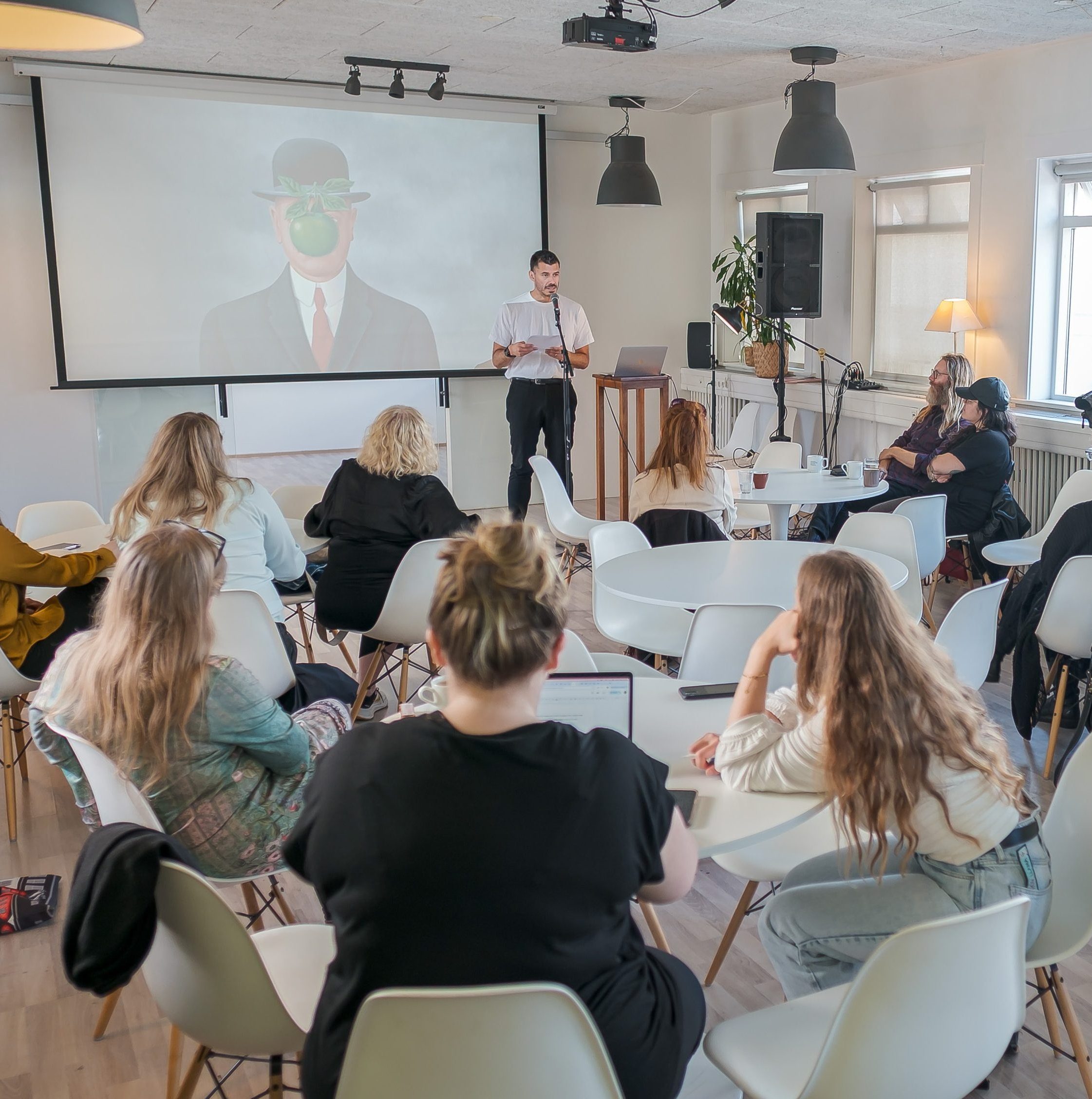
Introduction
The body is always present in the vocalization or live delivery of a text. Communication is not purely mental or conceptual, as it may be when we read a written text privately. The relationship is not between the work and the audience, but between the performer and the audience. The work is the cause, the medium, and the consequence of the act of verbalization.
Being aware of this—and taking it into account both during preparation and in the poetic act itself—allows us to deepen our communicative tools and make more effective and aesthetically meaningful use of the resources available to us.
In this module, we will explore some of the theoretical and historical foundations of the performative dimension of the text, while attempting to recognize and appreciate the elements and resources we employ in our own practice as agents of the spoken word.
Performance
There are many ways to define performance and trace its origins. In general, its emergence is associated with the artistic experimentation of the 1960s. Its essence lies in the concept of action or active creation: the artwork is understood as the creative process itself rather than its final result.
The act of creation constitutes a hybrid genre, as it can be approached as a material (visual) process, as theatricalization (stage improvisation), as a musical phenomenon (sound creation), or from many other perspectives. As soon as language becomes involved—or even silence, when it carries conceptual value—it can also be analyzed as a literary phenomenon.
Indeed, the development of performance, and of the concept of performance over time, has been sustained by different disciplines and contexts according to various schools, collectives, and geographical locations. Throughout much of Europe, the United States, and East Asia, performance continues to be formally situated within the visual arts and has largely been theorized from that perspective. In Latin America, however, its strongest roots lie in poetry. In particular cases, such as the Buenos Aires cultural movement that emerged after the fall of the Argentine dictatorship, performance evolved from ideas concerning the reinvention of theater and from artists trained in that field.
Poetic performance, in particular, can be understood as a combination of two genres, but also as a transformation of the very concept of poetry—and of text more broadly—that challenges established conventions and proposes a redefinition of the literary event. Understanding text as action opens up a field of analysis and projection that includes perceiving it as ephemeral, situational, collective, sensory, open-ended, and embodied. While these characteristics may seem innovative or revolutionary when associated with literature, they are also, in many ways, inevitable.
Poetry as Literary Action
Although this module focuses specifically on poetry, any text can be considered poetic once it leaves the written page and becomes action. Reading aloud the list of ingredients on a shampoo bottle can constitute a performance if it is carried out in the appropriate space, at the appropriate moment, and with the appropriate intention.
We should ask ourselves whether, now that we have entered the second quarter of the twenty-first century, it still makes sense to think of poetry separately from poetic performance and all its possible intermediate forms. Freeing the text from its purely logocentric character allows us to understand its full potential as a creative tool.
Rather than attempting to define or delimit poetic performance, our aim is to understand its playful, sonic, and physical dimensions—even in poetry readings or stage presentations that have no explicit performative ambition. The boundaries of a stage action are not determined by theoretical definitions, but by aesthetic intentions and the meanings they generate.
At the same time, following Marshall McLuhan’s idea discussed in the previous module—that the message lies not in the content but in the form—it is essential to approach poetic presentation or performance from the perspective of its interpretive breadth and versatility.
Since performance has become an accepted and everyday format within the poetic sphere, everything that may be called a poetry reading now exists within a broader landscape of representational possibilities. Performing the same text with the same intention and the same scenic resources does not necessarily produce the same work. Once we understand the delivery of a text as an act in itself—one that transcends the text alone—it inevitably enters into a unique relationship with the space and with the audience. This grants each performance unrepeatable qualities. Consequently, every live presentation of a text before an audience becomes ephemeral, a creative process—in other words, a performance.
References:
Garbatzky, Irina Ruth. Poesía y performance. Formas de la teatralidad en la poesía de la apertura democrática rioplatense (2011).
Lorente, Núria. Hacia la transformación de la poesía en acontecimiento: la performance poética (2019).
Some Examples
Poetic action or poetic performance is an artistic practice best experienced in person. Some of the materials presented here are audience recordings of limited technical quality. They have been selected solely to illustrate the diversity of live performance practices.
Cristian Forte & Harald Muenz, müll fällt an (2017)
https://www.youtube.com/watch?v=MNcZB9TbK1E
Yukta & Cosmin Perta, Camarade (2019)
https://www.youtube.com/watch?v=MNcZB9TbK1E
Elsye Suquilanda, Introducción al Chichoismo (2013)
https://www.youtube.com/watch?v=5kw0ALVKB4U
Martín Barea Matos, Tormenta in Love (2022)
https://www.youtube.com/watch?v=uoZDKSDhkKI&list=RDuoZDKSDhkKI&start_radio=1