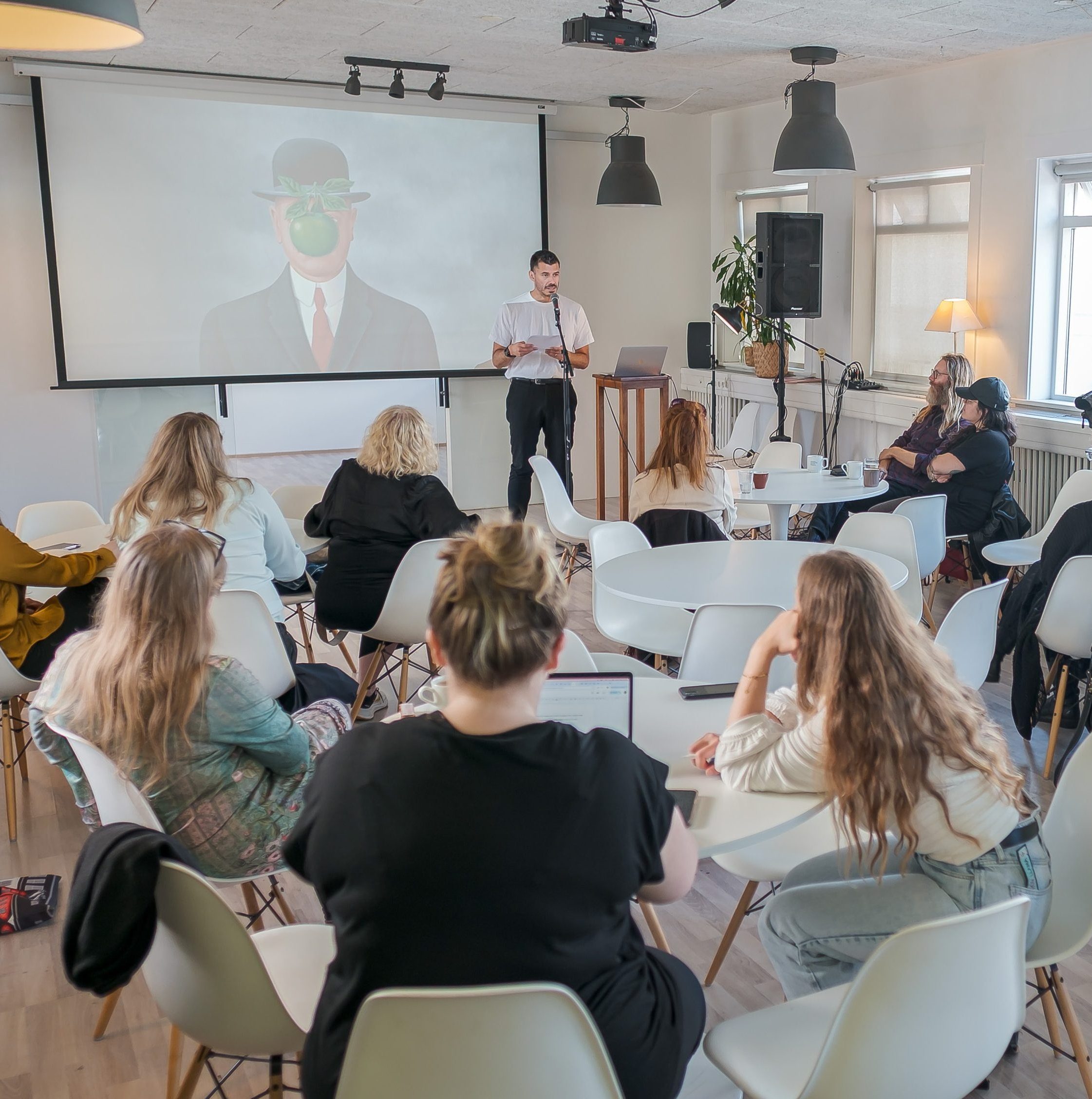
Poetry in the Body: An approach to Performance Poetry

Wishlist Share

About Course


Writing, in addition to being all the other things it is, is a form of communication. The process is not complete until it has conveyed something to others. For this, we use the codes of language, the signifiers and meanings that we have learned through formal and informal methods, both rational and sensory. It is our main tool, but also our limit. We never have certainty that the message has reached its destination as we intended, and perhaps that is not impossible. Literary texts are interpreted in many ways, sometimes in contradictory ways. This fact does not force us to abandon the precision and energy of the content, but it does allow us to consider the potential for possible echoes.

A classic example is the poem “Verde que te quiero verde” by Federico García Lorca, in which “green” represents life for some and death for others. How relevant is this difference? The relationship between the two concepts is intrinsic and inevitable. The poem has moved millions of readers around the world, continuing to do so almost one hundred years after it was written. Wouldn’t it be an admirable achievement to write a text about death that inspires hope in others?

This course is aimed at writers and translators interested in exploring the communicative value of text beyond its strict meaning and the framework of specific languages. Graphic presentation, sound, stage presence, rhythm, interpretive context, and technological resources are some of the tools that allow us to amplify the emission of words and other characteristics they carry beyond their meaning.

We will focus on the poetic text, first for its versatility. It could be said, in a rhetorical play, that a poem is anything except what is not a poem. And second, because it is necessary to concentrate on a specific and manageable object of study. Each participant will begin with their own notion of a poem and work from there. However, the exercises and discussions proposed here can also be useful and inspiring for a sensory and multifaceted approach to any type of writing.

Show More

Course Content

Module 1: Visual Poetry
What is a poem? The intrinsic freedom of poetic creation makes it difficult for literary theory to define and delimit poetry. When we try to do so, we are often left with the impression that any proposed description excludes some author or poem we know. As we mentioned in the introduction, a poem is anything except that which is not a poem. If we focus on the written poem—the kind that can be represented with symbols on a surface or page—and allow for the inevitable exceptions, there is one element that distinguishes it from non-poetic texts: its design. A poem is almost always written in verse, includes blank spaces, and has a beginning and an end that are immediately visible. It is not confined within a fixed format or governed by a syntactic rulebook. Every margin, every line break, every spacing choice, every element forms part of the creative act. It is from this sense of visual and structural flexibility that we will examine the design of the poem and its potential.

Module 2: Text as sound
Every poem is, in some way, a form of song. Even when we conceive it for reading aloud or as written text, it will reach the reader as a form of sound, with a voice and a cadence. There are many resources that enhance the sonic quality of a poem, such as alliteration, repetition, meter, or rhyme, as well as their variations and adaptations in the more widespread free-verse poetry of our time. When we encounter the barrier of language—that is, when presenting work to audiences who do not know or do not master the language in which we are performing—the sonic dimension of the text becomes central to conveying emotion, importance, or content. As a way of understanding the whole, we will analyze parts or components of the text as an auditory experience and study examples of artists who make these aspects visible.

Module 3: Translation
Literary creation is based on language, and therefore authors usually feel more involved and expressive in their mother tongue, or in the language they use daily for life. For this reason, we depend on translation in order to communicate our work to those who do not know the language in which we work. Those of us who live and work in different languages often experience this dichotomy as urgent, as a vital need to share with the environment in which we move daily. And we face many difficulties in the process: finding a good translator, lack of funding, uncertainty in pronunciation, discrepancies in sound, and finding the necessary circuits and channels for dissemination. In this module we will explore alternative forms of translation that can facilitate communication and the search for some kind of language without borders. We will focus especially on the practical part, on exercises and proposals that allow us to test our own paths, applicable to the languages we move between, integrating as far as possible what we have practiced in previous modules.

Module 4: Technique
This module explores technique as both constraint and tool in poetic creation. Far from being neutral, technical choices—structure, repetition, voice, digital tools, and composition methods—shape meaning and perception. We will investigate how formal decisions generate content, and how different techniques can be used not to limit expression, but to expand it.

Module 5: Performance
This module focuses on poetry as an event in time and space. Performance shifts the poem from page to body, voice, and presence, emphasizing rhythm, sound, and collective experience. We will examine how interpretation, gesture, and audience interaction transform written text into a living act of communication.