
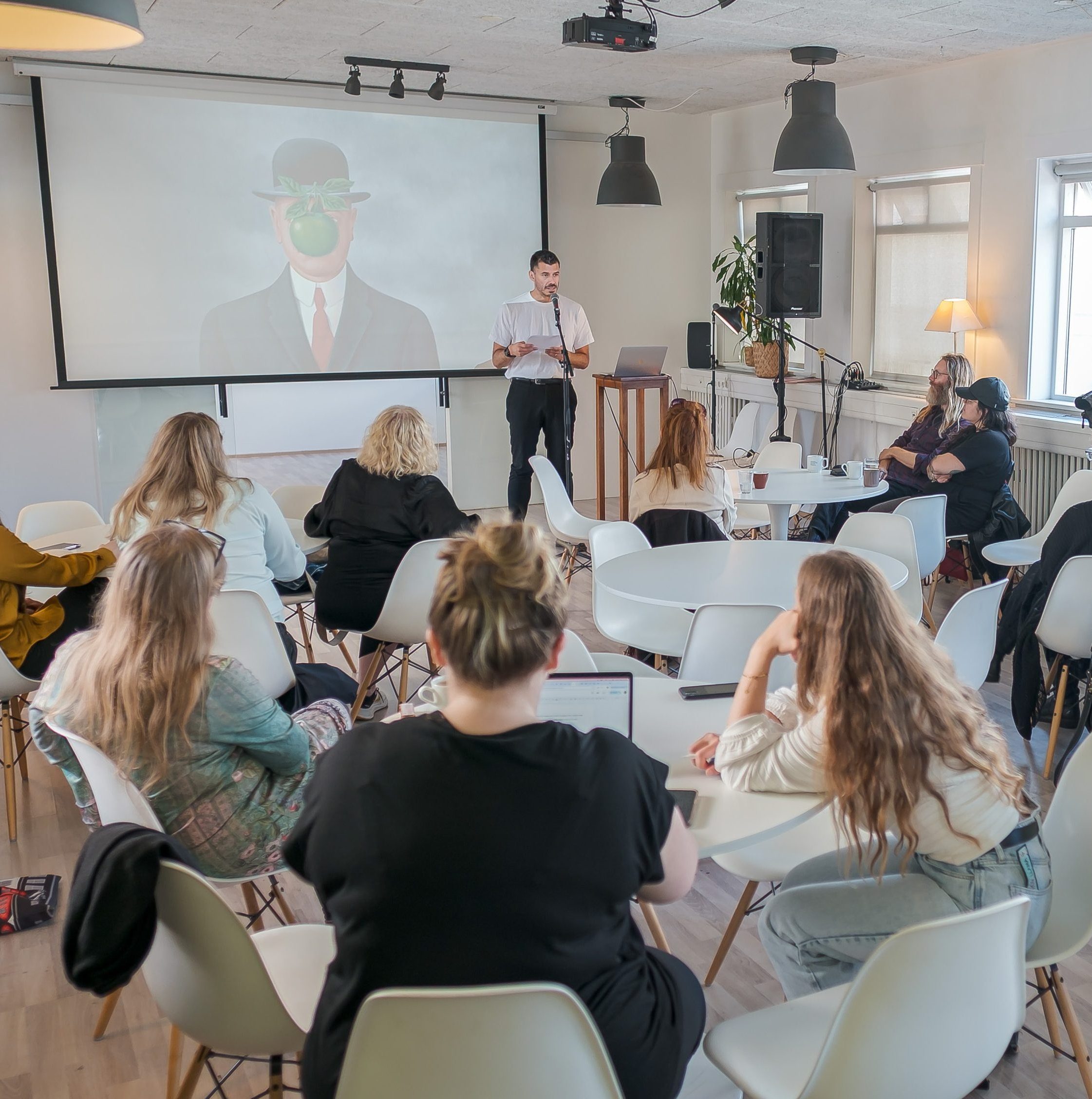
Once upon a time, humans believed time moved in a steady, constant direction. A minute for you was thought to be the same as a minute for an alien traveling at unimaginable speeds. The tick of the clock marked the rhythm of our days, the unchanging measure of existence.
But both writers and scientists began to question the nature of time. Soon, they realized it was far less straightforward than it seemed. Einstein revealed that time is relative: it bends and stretches according to the observer’s motion. Marcel Proust, within the span of a single moment, could contemplate an entire lifetime.
We know this intuitively. Waiting in a queue can make time crawl. A night of laughter passes in a flash. Time, it seems, is not fixed: it dilates and contracts with emotion, attention, and memory.
For the writer, time is a playground. You can bend it, fracture it, suspend it. You can make a second feel eternal or a decade vanish between sentences.
In this session, we’ll explore how time has been imagined by writers and thinkers, and how you can harness its elasticity to shape your own worlds.
Conceptual Frame
Time is not a straight line. It bends, folds, and vanishes depending on who we are, where we are, and how we feel. For centuries, we believed time was a neutral backdrop: seconds, minutes, and hours flowing evenly for everyone. But the 20th century changed that belief forever.
Einstein revealed that time is not universal. It stretches and contracts depending on speed and gravity. There is no single, absolute clock ticking behind the universe: only many personal clocks, each bound to its observer.
I encourage you to learn more about this fascinating insight, through this simple explanation of time dilation: Click Here to Watch Video.
Around the same period, philosopher Henri Bergson proposed a different kind of time: duration (la durée). Not the mechanical time of clocks, but the living time of consciousness: the inner flow that we experience as memory, anticipation, and change. For Bergson, this duration cannot be divided into neat units; it moves like music, continuous and alive.
And it was Marcel Proust who translated this philosophical insight into literature. In In Search of Lost Time, the past is never gone, it waits, hidden in the folds of the present, until a taste, a smell, or a sound awakens it. Through memory, a single instant can bloom into an entire lifetime.
Let me share a short reading from Swann’s Way, the first volume of In Search of Lost Time:
{Reading of Proust, refer to video}
Writers, then, work with time as sculptors do with clay. We can stretch it, loop it, fragment it. We can let time dissolve into dream or slow it down until thought becomes motionless. In writing, time is not something to follow: it is something to create.
Exercise 1: Bending Time
Purpose: To explore how duration expands through inner perception.
Take a brief, ordinary instant: sipping coffee, tying your shoes, glancing out a window.
Describe that moment as if it contained the weight of years. Let memory, emotion, and reflection spill into it.
Stretch the second until it becomes a day, a week, a year, a lifetime.
Ask yourself:
— What hidden memories or sensations awaken inside this instant?
— Where does the present dissolve into the past or the imagined?
— When you stop measuring time by clocks, what new rhythm appears in your writing?
Exercise 2: The Shattered Timeline
Purpose: To explore how emotion, rather than chronology, gives a story its shape.
Time rarely unfolds in a straight line. Memory skips, emotion distorts, imagination leaps forward or back. In writing, this elasticity can mirror the true texture of human experience – fragmented, recursive, alive.
Write a short scene (around 250-750 words) in which events do not occur in chronological order.
Begin at the end with a consequence, an echo, or an aftermath.
Then jump to the middle, where something essential happens but not necessarily what explains it.
Finally, return to the beginning, not as exposition but as revelation: a gesture, image, or word that gives emotional context to what came before.
Let emotion, not sequence, guide the structure. Use rhythm, tone, or sensory detail as your compass. The reader doesn’t need to “understand” the order logically; they should feel its coherence.
Ask yourself:
— What happens to meaning when time fractures?
— Does the emotional truth of the scene survive (or even intensify) when the timeline breaks apart?
You might find that the story makes more sense this way, as if its true order was never linear but emotional.